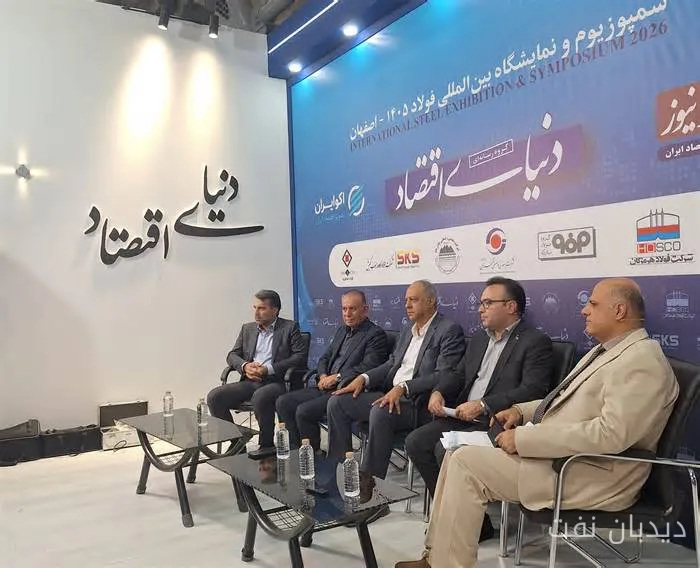
Ahmad Sadeghian, CEO of Ghadir Iranian Iron and Steel Company, emphasized the importance of revising energy allocation policies for the steel industry at the 28th International Steel Symposium and Exhibition 1405, which was held last week in Isfahan.
Energy Crisis and Its Impacts on the Steel Industry
Sadeghian, during a specialized panel of the Donya-e-Eqtesad media group titled "High-Risk Winter for Steel; What is the Industry's Strategy to Overcome the Energy Crisis?", warned about the exacerbation of energy imbalance and its consequences on production, exports, and competitiveness in the steel industry. He stressed that this imbalance could lead to serious problems in the industry and emphasized the necessity of balanced infrastructure development and reforming energy policies.
Read more: Expansion of Oil Trade between Iran and Russia Despite Sanctions and Challenges
Two Strategies to Face the Energy Crisis
The CEO of Ghadir Iranian Iron and Steel Company further introduced two main paths to address the current energy crisis. First, increasing production and improving energy distribution, and second, saving and enhancing efficiency in industrial units. Sadeghian referred to the actions taken within the Ghadir Iranian group, stating that in the pelletizing plant of this group, water consumption has been reduced to about 50 percent of global standards.
In addition, he spoke about measures taken to reduce electricity and gas consumption through process and equipment improvements. According to him, one of the strategies for increasing energy efficiency is recovering waste heat in sponge iron units and using modern technologies. In some sponge iron production processes, by recovering exhaust gases, part of the wasted heat can be converted into electrical energy and reused in the production cycle.
Sadeghian also criticized the uniform energy allocation methods during periods of restriction, stating that energy allocation based on a fixed percentage of demand or past consumption does not necessarily lead to maintaining production across the entire steel chain. He noted that energy allocation policies should be revised in a way that preserves the production of the final product and the overall efficiency of the chain, rather than simply reducing the share of consumption of industrial units uniformly.
Read more: Masoud Nili: Stabilizing Energy Prices Causes Imbalance and Pressure on the Economy · Saeed Shojaei: Energy Policy Should Consider the Balance Between Energy Economy and Industry