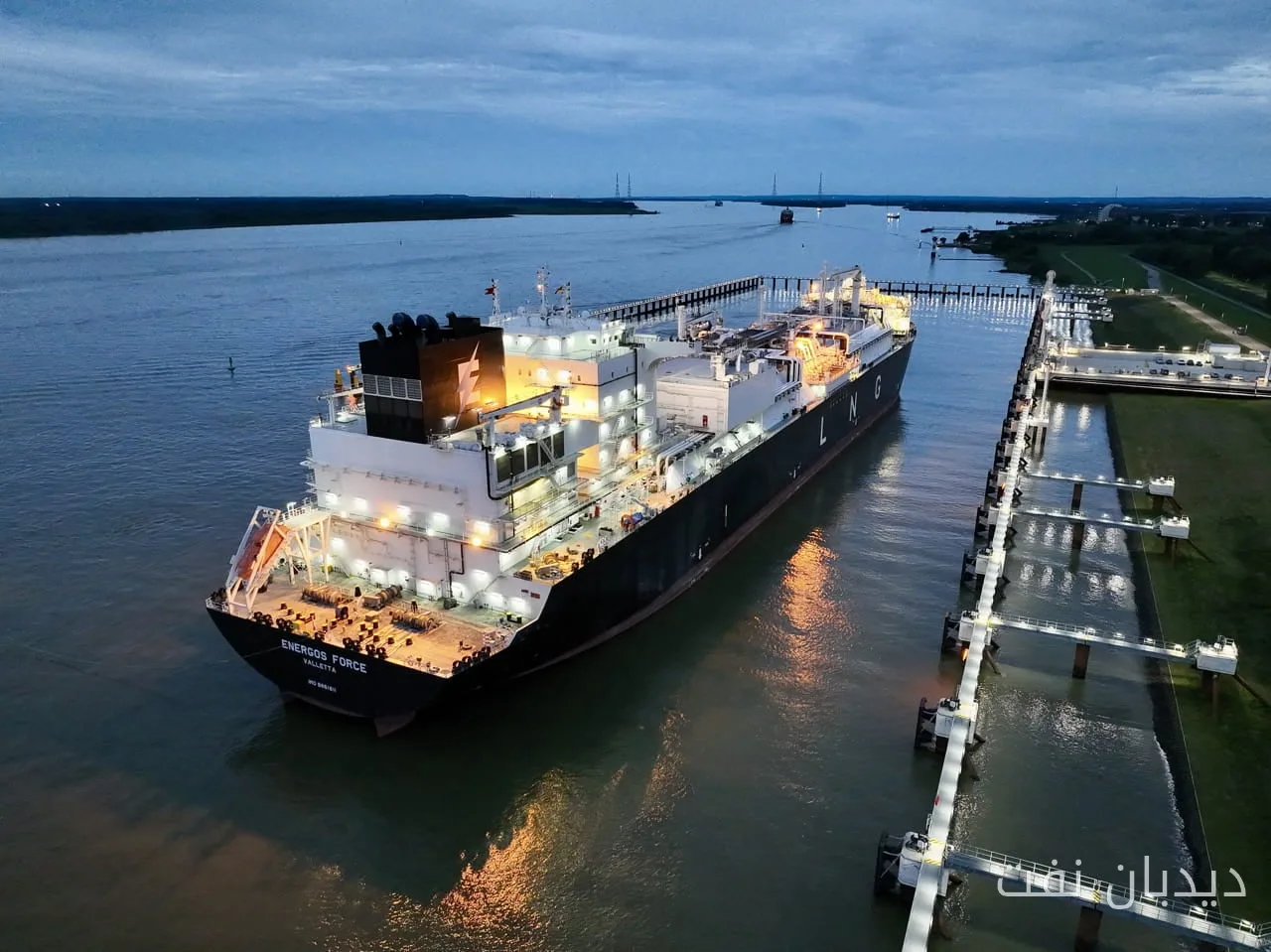
The Floating Storage and Regasification Unit (FSRU), measuring 294 meters in length, has arrived at the new liquefied natural gas (LNG) terminal in Estade. This event marks the beginning of the necessary preparations for the terminal's launch, and it is expected that gas from this terminal will start flowing into the German gas network from November.
Initiation of Terminal Startup Process
Deutsche Energy Terminal (DET), the German state-owned company responsible for LNG terminal operations in the country, has begun the necessary preparations for the launch of its new terminal. The arrival of the FSRU vessel named Energos Force at the Estade-Bitzfeld industrial port signifies the start of this process. This vessel is intended to meet Germany's natural gas needs.
DET's CEO, Dr. Peter Rutgen, stated: "With the return of the regasification vessel to the Estade dock, the terminal startup process begins. We expect the first fully loaded LNG tanker to arrive here in early November." He also emphasized that this terminal will contribute to energy security for millions of households.
Providing Natural Gas for Germany's Needs
According to forecasts, the Estade terminal will be able to supply up to 3.2 billion cubic meters of natural gas to the German gas network by 2027. This amount will be sufficient to meet the heating energy needs of approximately 2.6 million four-person households over a year. NPorts has created a dock specifically for this FSRU and the onshore terminal, which is still under construction.
The Federal Minister for Economic Affairs and Energy of Germany, Katharina Reich, stated: "With the arrival of Energos Force in Estade, the concept of energy supply security is clearly demonstrated in practice. This FSRU, which is anchoring at the terminal today, can help provide reliable energy for millions of households starting in November."
The FSRU vessel Energos Force, built in 2021, has a width of 47 meters and a deadweight tonnage of 94,361 metric tons. This vessel can regasify up to 500 million standard cubic feet of gas per day in winter using steam boilers in a closed-loop system and can regasify up to 750 million standard cubic feet of gas per day in summer using water from the Elbe River in an open-loop system.
NPorts CEO, Holger Banik, expressed: "We are pleased to see that the plans we have developed together are now coming to fruition. With this dock, the necessary infrastructure for the commencement of operations at the Estade terminal has been established."
According to DET information, the projected input capacity for 2027 of up to 3.2 billion cubic meters of gas represents the maximum output of the system under ideal conditions. At the same time, lower input volumes due to actual delivery load sizes must also be taken into account.
Currently, DET is responsible for the terminals in Brunsbüttel, two terminals in Wilhelmshaven, and the Estade FSRU project.
Read more: The government is implementing the plan to transfer gasoline quotas to bank cards · Increase in LNG imports from Yamal by the European Union; will dependence on Russia continue?