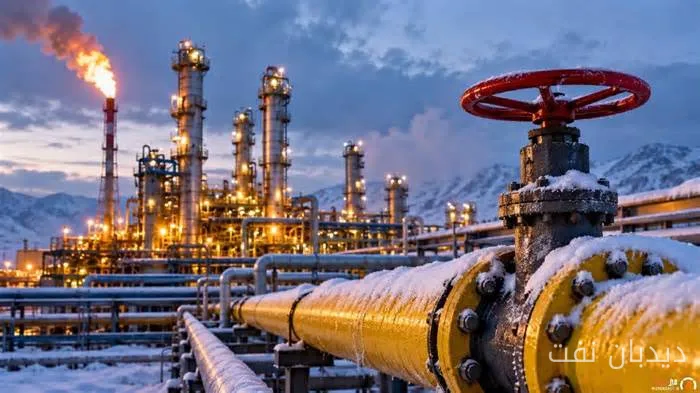
Gas restrictions for petrochemicals in winter can have widespread consequences on production and related costs in this industry. This restriction is not limited to a decrease in production volume and can incur additional costs such as halting and restarting units, reducing profit margins, and disrupting exports.
Calculating Actual Damages
To accurately estimate the damages caused by gas restrictions, it is necessary to determine the amount and duration of the feedstock limitation and to examine its impact on the production of each complex separately. Samaneh Ghaibi, a petrochemical industry expert, emphasized that gas is considered the main feedstock in methanol units, and its restriction can affect the production of ammonia and subsequently urea.
Read more: 100% Increase in Production at Karun Oil and Gas Exploitation Company
For example, if the nominal capacity of a methanol complex is considered to be one million tons annually, its daily production capacity, assuming full operation throughout the year, would be about 2,740 tons. If such a unit operates at 50% capacity for 15 days, the lost production would amount to approximately 20,500 tons. Assuming the price of each ton of methanol is $250, the sales value of the unproduced product would be about $5.1 million.
Effects of Restrictions on Costs and Profit Margins
Ghaibi explained that not all of this figure should be considered a loss for the company, as some variable costs are not incurred during production stoppage. If the difference between the selling price of the product and the variable costs per ton is hypothetically $50, the impact of reduced production on the profit margin in this example would be about $1 million. Additionally, the costs of halting, restarting, and potential effects of sales contracts should be calculated separately.
These figures are merely a computational example, and to determine the actual damages for each company, it is necessary to examine the operational and financial information of that complex. The production structure of petrochemical complexes also plays a significant role in the extent of damages. In urea complexes, a reduction in gas can initially limit the production of ammonia and then urea.
Ghaibi also emphasized the importance of early notification regarding winter restrictions. Although supplying gas to the residential sector is prioritized during cold days, timely announcement of restriction plans can assist petrochemical complexes in managing repairs, inventory, and sales contracts, thus reducing some preventable costs.
Read more: Iran's Daily Crude Oil Production Increases to 3.7 Million Barrels · NGL 3100 Feedstock Sales Contract Signed in Dehloran



