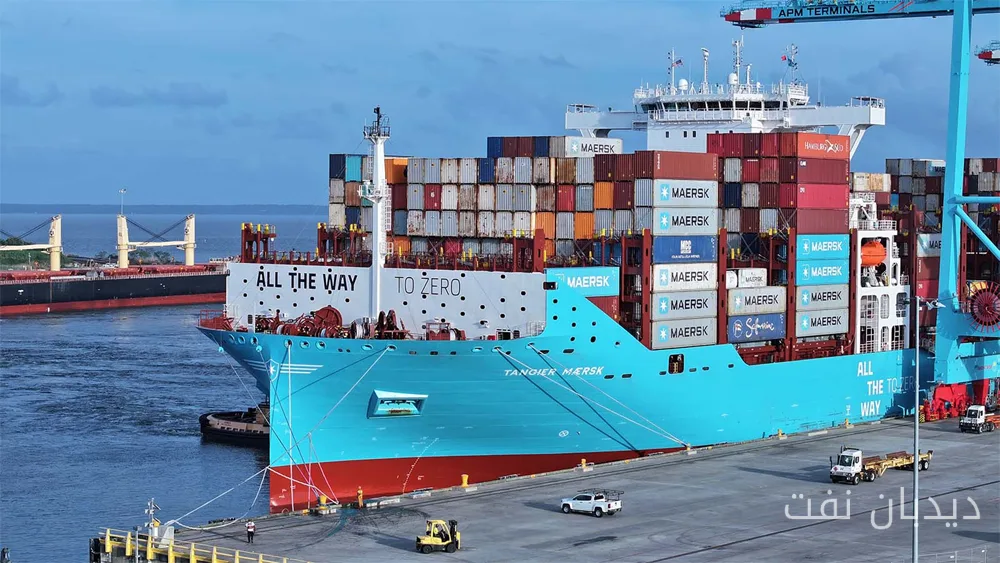
Maersk recently completed the first commercial bioethanol refueling for a container ship in the United States. This refueling utilized a 100 percent bioethanol blend from the American producer Poet, as part of an ongoing trial by Maersk to evaluate alternative fuels and bioethanol.
Refueling Details and Ship Characteristics
The refueling operation took place on the Tangier Maersk, which is a medium-sized ship measuring 270 meters in length and has a capacity of 9,000 TEU. This ship, built in China and delivered in February 2026, is equipped with a dual-fuel engine capable of operating on methanol. Maersk previously explained that due to the similarities in properties between bioethanol and methanol, it is testing the fuel exchange capabilities between these two types of fuels for its dual-fuel vessels.
Read more: Japan's Maritime Force Joins the Wind Energy Market with a New Operational Service Vessel
Collaboration with Other Entities and Operational Implications
The company Poet, recognized as the largest bioethanol producer in the world, supplied the plant-based bioethanol for this operation. This collaboration also included Kirby Corporation, which supported the marine refueling and fuel transportation operations. The Port of Houston also collaborated in this operation with port coordination and necessary infrastructure, and the United States Coast Guard supported the legal requirements necessary for conducting the refueling operation.
Maersk stated that this operation has provided valuable real-world experiences. This trial helps the company gain insights into operational issues, infrastructure, supply, and the supply chain for using bioethanol as marine fuel. While bioethanol benefits from an established production base, Maersk has also emphasized that existing infrastructure and compatibility with alcohol-fueled vessels will depend on the availability of fuel, regulations, and operational readiness in the marine value chain.
This operation is based on previous bioethanol trials on the Laura Maersk and Antonia Maersk ships and demonstrates Maersk's ongoing commitment to advancing credible pathways for progress in the energy transition of the shipping industry.
The company announced in December 2025 that it had conducted an initial trial using E10 (10 percent bioethanol) in a bioethanol-methanol blend to confirm safe integration and performance. They have also examined issues such as combustion quality, how the fuel burns, potential corrosion problems, and pollutant testing to see if there are any differences. The company is also looking to test a 50 percent bioethanol and 50 percent methanol blend on the Laura Maersk and a 100 percent bioethanol test.
The United States is the largest bioethanol producer in the world and, along with Brazil, accounts for nearly 80 percent of the global market. Poet has stated that bioethanol produced in the U.S. is manufactured on a commercial scale, with the company producing over three billion gallons annually across its network of 35 biorefineries.
Maersk has announced that it will continue to explore alternative fuels and various availabilities, believing that the future will include a range of fuels to achieve set transportation goals.
Read more: The International Maritime Organization Emphasizes the Importance of Implementing Maritime Laws · UCL Energy Institute Report: The Maritime Transport Industry is Lagging Behind Carbon Emission Goals for 2030