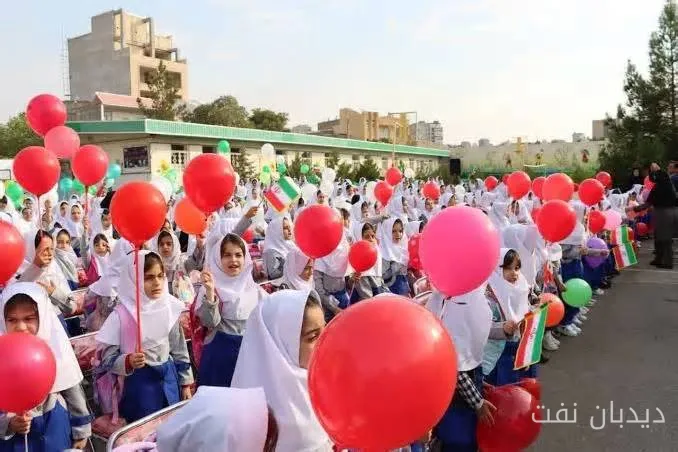
Reza Hekimzadeh, the Deputy Minister of Primary Education at the Ministry of Education, highlighted the importance of preserving students' learning time and addressed the challenges present in school closure policies. He pointed out that the learning time in our country is significantly less compared to many other countries, and this issue affects students' learning outcomes.
The Necessity of Preserving Learning Time
Hekimzadeh stated: "Every time, for any excuse, the first place we close is the school." This issue reflects a lack of sufficient attention to students' learning and education time. He added: "Air pollution, energy imbalance, and even snowfall are among the factors that sometimes lead to school closures; while these decisions are not necessarily beneficial and harm learning time."
Read more: The IRGC reported the destruction of the fourth MQ-1 drone in the eastern Strait of Hormuz
The Experience of the COVID Era and Its Effects
The Deputy Minister of Primary Education referred to the experience during the COVID era and said: "During this period, Iran was among the countries with the longest duration of school closures." He criticized this issue, stating that many countries, despite having advanced technological facilities, reopened their schools after about a month. Hekimzadeh emphasized that reports from the World Health Organization indicate that schools are not the epicenter of COVID and that children are not at serious risk, but due to media hype, schools were closed for a long time, which harmed the education of a generation.
The New Policy of the Ministry of Education
Hekimzadeh further referred to the new policy of the Ministry of Education for managing school closures and stated: "This ministry has become the decision-making authority regarding school closures, and instead of nationwide closures, decisions can be made based on the conditions of each region." He added: "The conditions of provinces and even different areas within a province can vary, and decisions should be made according to the conditions of each region."
He also referred to a research report prepared by the Educational Studies Research Institute and said: "The results of this study have shown that school closures do not significantly impact reducing energy imbalance, and therefore, such decisions should be made with more caution." Hekimzadeh emphasized that in many countries, even when air pollution levels exceed those that we announce for school closures in Iran, schools continue to operate.
Cultural Development and Managing Learning Time
The Deputy Minister of Primary Education emphasized the necessity of cultural development to reduce school closures and said: "If we provide the necessary education and reconsider our consumption behavior, we might be able to significantly prevent school closures." He concluded by stating that to manage learning time and prevent unnecessary closures, serious cultural development and reevaluation of some policies are needed.
Read more: Ukraine and Russia agreed to halt attacks on energy facilities · The unity government faces structural challenges and social crises