The World Shipping Council (WSC) has released a new report presenting the results of a survey from seven countries and over 93,000 cargo inspections, revealing a concerning rate of safety deficiencies. According to this data, one in every ten shipments has safety issues, and the rate of deficiencies has increased over the past decade.
Identified Issues in Shipments
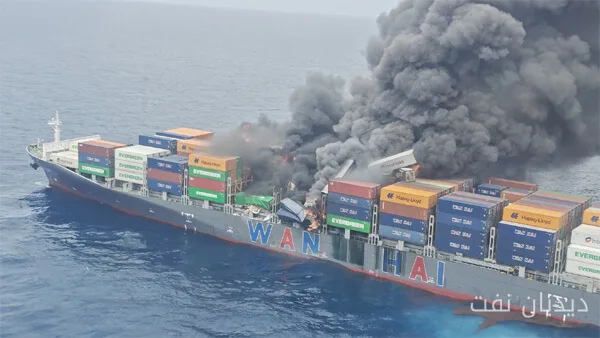
Identified issues include incorrect documentation, improper marking and labeling, inadequate packaging, and insufficient securing of cargo, all of which can increase the risk of cargo damage, container loss, and fire on board ships. This comes as the maritime transport industry continues to grapple with safety challenges, with notable fires at sea endangering the lives of seafarers being highlighted.
Statistics and Analyses Related to Deficiencies
The World Shipping Council refers to the latest statistics provided by insurer Allianz, which indicate that a fire occurs on a container ship every 17 days. Joe Cramack, President and CEO of the World Shipping Council, expressed concern, stating, "Finding deficiencies in more than one-tenth of inspected units is very high." He emphasized that proper declaration, packaging, securing, and marking are fundamental safety requirements, and failure to comply with these requirements endangers lives.
Reports to the International Maritime Organization (IMO) have been submitted from 93,079 inspections conducted in 2025 by the countries of Chile, Finland, Germany, the Netherlands, South Korea, Sweden, and the United States. In these inspections, deficiencies were identified in 9,645 inspections, indicating a rate of 10.36 percent.
Data analysis shows that from 2017 to 2025, the average deficiency rate has been over 9 percent, while it decreased to 6.5 percent and 7.4 percent in 2020 and 2021, respectively. In the past three years, this rate has increased to over 11 percent in 2024 and a three-year average of 10.9 percent.
The World Shipping Council also pointed out deficiencies in international regulations for hazardous goods and called on IMO member countries to address these gaps. The council emphasized that containers currently carry thousands of lithium batteries without declaration. According to the International Energy Agency, global use of lithium-ion batteries in 2025 is expected to be six times higher than in 2020, and demand for batteries is expected to double by 2030.
After the IMO ceased the publication of its annual report in 2024, the World Shipping Council took on the responsibility of compiling and publishing results, noting that the end of statistical publication creates significant gaps in the global safety picture for the maritime transport industry.
Cramack further added, "Countries have a responsibility to inspect and effectively enforce cargo safety regulations." Additionally, the World Shipping Council expressed concern that only seven countries out of more than 170 IMO member countries reported container inspection results for 2025.