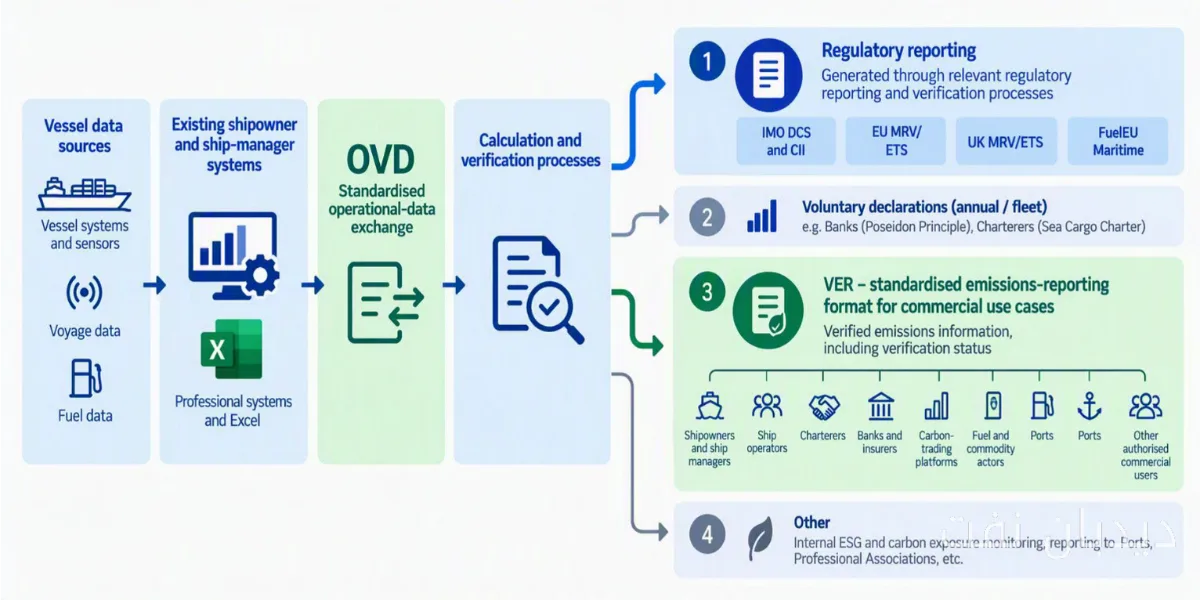
The Joint Industry Working Group (JIWG), chaired by BIMCO, has recently released version 1.0 of the Greenhouse Gas Reporting Frameworks (VER) and Operational Data for Ships (OVD). These frameworks have been developed to create a common approach for greenhouse gas reporting in the maritime industry and will assist in more efficient data exchange.
Details of the OVD and VER Frameworks
The OVD and VER frameworks are designed voluntarily and do not create any new reporting obligations. These frameworks provide a common approach that organizations can use to support more efficient and consistent data exchange. OVD presents information related to operational data and fuel consumption of ships in a structured format. This framework defines common data elements, names, units, and structures, allowing for consistent interpretation of information by different systems and organizations.
Read more: Seatrium's HVDC platform is being sent to Europe
Response to Reporting Challenges
The need for accurate and reliable reporting of greenhouse gas emissions in the maritime industry has increased due to the IMO data collection system and the EU monitoring, reporting, and verification system. Given that these requirements pursue different objectives, the use of various data and formats can lead to inconsistencies and redundancies in the reporting chain. For this reason, the JIWG group has focused on developing a common approach that facilitates data transfer between different systems.
Overall, the OVD and VER frameworks will serve as tools to reduce the reporting burden and facilitate the exchange of reliable and trustworthy data in the maritime industry. These tools will allow ships, shipping companies, software providers, and other authorized users to exchange data in a consistent and effective manner, improving reporting and verification processes.
Read more: Lloyd's Register and BPA: Ports must be ready for the arrival of nuclear ships · Transformation in the maritime industry using artificial intelligence by Orbius