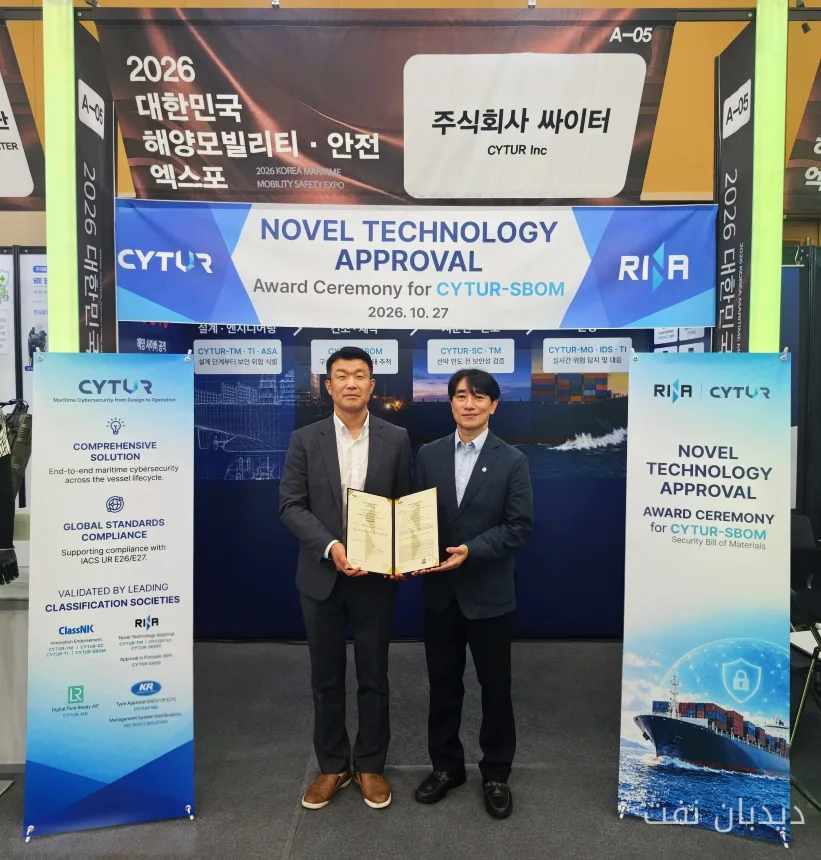
CYTUR Inc., a specialized company in maritime cybersecurity led by Yang Hyun-Jo, announced that its maritime cybersecurity asset management platform, CYTUR-SBOM (Security Bill of Materials), has successfully received an innovation certification from ClassNK Japan and a new technology certification from RINA Italy.
Receiving Two International Certifications
These two certifications mark an important milestone for CYTUR-SBOM and demonstrate international recognition of its technological innovations and potential for maritime applications. This platform integrates information regarding the hardware and software assets of maritime equipment and provides a systematic view of the cybersecurity status.
Read more: Fagro Signed a Contract to Review Unexploded Ordnance Along the Route of Undersea Cables
The Importance of Asset Management and Cybersecurity Documentation
The ClassNK innovation certification program for products and solutions is an independent certification program that evaluates the innovative features and technical capabilities of products and solutions. The RINA new technology certification also assesses the technical capabilities and maritime applications of emerging technologies.
With these certifications from two important international classification societies, CYTUR has strengthened the global credibility of CYTUR-SBOM and provided a stronger foundation for expanding its business among editors and manufacturers of maritime equipment.
With the implementation of the integration requirements UR E26 and E27 by the International Association of Classification Societies (IACS), systematic management of assets and cybersecurity compliance documentation in shipbuilding and maritime industries has become a significant issue. These requirements are mandatory for ships that have contracted for construction from July 1, 2024.
Shipbuilding projects involve a large number of equipment manufacturers and system integrators, which results in the distribution of security information and hardware and software configurations among multiple suppliers. Manually collecting and managing this information can lead to loss of records, version mismatches, and significant time and labor requirements for preparing and verifying classification documentation.
CYTUR-SBOM is designed as an integrated platform for managing cybersecurity assets and supporting regulatory compliance specifically for the maritime industry to address these challenges. This platform allows shipbuilders, system integrators, and equipment manufacturers to centrally manage information about the assets of specific ship computer systems and systematically check security requirements.
Key capabilities of this platform include integrated management of hardware and software assets, automatic generation of network topology diagrams and data flow diagrams (DFDs) based on recorded information, and recording of security assessment results. Additionally, this platform correlates recorded information with known cybersecurity vulnerabilities (CVEs).
Previously, CYTUR has also received ClassNK innovation certifications for CYTUR-TM, CYTUR-SC, and CYTUR-TI, as well as RINA new technology certification for CYTUR-TM and CYTUR-SC, and an Approval in Principle (AiP) for CYTUR-SAVD.
By receiving certifications from both classification societies, CYTUR has expanded its portfolio to four certified or approved products in each society, enhancing its global competitiveness in cybersecurity technologies throughout the ship lifecycle.
Yang Hyun-Jo, CEO of CYTUR, stated, "Maritime cybersecurity goes beyond securing individual devices. It begins with accurate identification and systematic management of the various components of equipment and software installed on a ship."
He added, "Receiving certification from both the Japanese and Italian classification societies is a significant achievement that demonstrates the international competitiveness of CYTUR-SBOM."
Read more: 30% Reduction in Energy Consumption of Large Industries Through Smart Technology, Deputy Minister of Communications · HELMS and ENTS Begin New Collaboration in Indonesia and East Timor