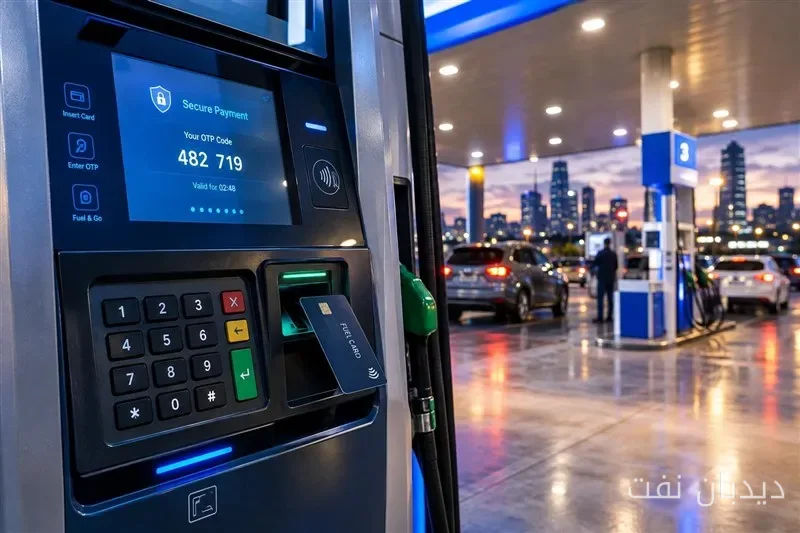
The plan to identify free fuel cards aims to eliminate the fixed code 1111 and replace it with bank authentication. In this plan, anyone with a valid bank card can authenticate by swiping the card and checking their national ID within seconds, and after refueling, they will receive a purchase receipt.
Details of the Plan and the New Refueling Process
In exchange for this inquiry, one thousand tomans will be charged by the banking network as a fee, and a one-time password will be printed on the purchase receipt; thus, the code 1111 will no longer be valid. Abbas Basafa, the director of the country's smart fuel system, announced that this plan is currently being implemented at some stations in Tehran and is expected to expand nationwide within three months.
Read more: Reducing Pressure in the Shipping Industry and Increasing Transit Capacity in the Panama Canal
The main goal of this plan is to reduce the operators' involvement at the stations, increase transparency, manage the allocation and withdrawal of fuel, especially in border areas, and prevent off-network supply. According to reported statistics, the share of withdrawals from emergency cards reached 40 percent in September, while the law mandates that 95 percent of refueling must be done through personal fuel cards.
Challenges and Consequences of the Plan
The cards of station operators were initially defined with the philosophy of "emergency refueling" to be used in exceptional cases such as forgetting or losing a personal card. However, in recent years, this tool has lost its primary function and has become a main channel for evading rationing. According to data from the smart fuel system, the share of withdrawals from emergency cards reached about 40 percent of total consumption in September, a significant distance from the legal obligations that emphasize at least 95 percent consumption through personal cards.
This situation has turned the nameless cards of the stations into one of the most vulnerable points in the distribution chain. Unidentified access to these cards has opened the space for operators to manage and sell fuel off the network. Unlike diesel, which records significant amounts of border smuggling, gasoline has a lower volume of exit from borders due to safety and flammability reasons. Nevertheless, domestic smuggling of this product has become a major challenge; estimates suggest that it reaches 4 to 5 million liters daily.
In the new method, the traditional process has been completely redefined. The applicant for refueling first visits the card reader connected to the Mana system and authenticates based on their national ID by swiping a valid bank card. At this stage, the 1000 toman fee for identity inquiry is deducted, and a one-time password is printed on the payment receipt; this password replaces the public code 1111, and without it, activation of the nozzle is not possible.
With this method, card management is effectively removed from the direct control of the station operator and entrusted to the central system. In fact, the device only allows refueling when the individual's identity details and consumption file are registered in the network. This data transparency not only eliminates the presence of fuel intermediaries and the diversion of products towards unauthorized industrial uses but also allows policymakers to manage demand intelligently and move towards equitable energy distribution patterns.
Read more: The U.S. Treasury Department Imposes New Sanctions on Iran and Russia's Financial Network · The Head of the Energy Commission of the Parliament Announced New Fuel Consumption Management Plans



