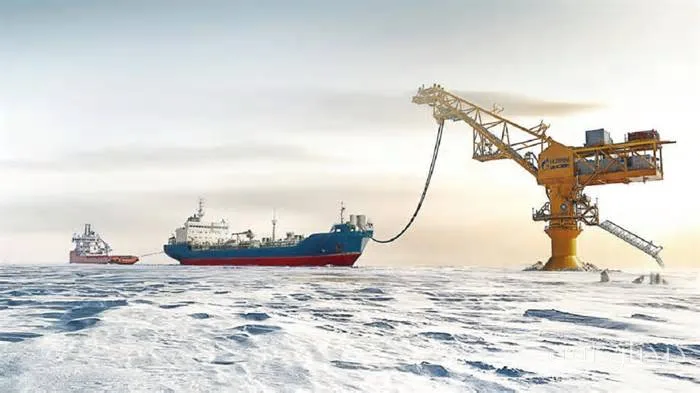
The European Union is revising its policy on the Arctic; a region that has become one of the main arenas for the competition of great powers due to energy resources, shipping routes, and military positioning. Brussels intends to abandon its efforts to achieve a multilateral and binding agreement to prohibit new oil and gas drilling in the Arctic.
Change in Political Priorities
The EU's official position against the development of fossil fuels in this region remains firmly stated, so this action does not mean a complete retreat from climate policy; rather, it indicates a departure from efforts to impose a legal ban at the international level. This change clearly reflects the challenges in climate diplomacy that are confronted with new geopolitical realities.
Read more: Increase in attacks on ships in the Strait of Hormuz; 24 ships targeted in two weeks
According to a report from the European Parliament, the revision of Arctic policy is set to emphasize security and defense, geoeconomic competition, and the protection of critical infrastructure alongside environmental priorities. This change is more an admission of the limitations of climate diplomacy in a world where competition for energy and resources has intensified than a declaration of victory for fossil fuels.
Competition for Energy Resources
The Arctic is no longer merely a subject of climate research and wildlife conservation. The retreat of ice, access to shipping routes, and the importance of natural resources have turned this region into a battleground for Russia, the United States, China, and European countries. Russia has a significant military and infrastructural presence in the north; China, despite not having independent territory in the Arctic, seeks to increase its economic and strategic influence in the region. The United States also considers the security of Greenland and its presence in the North Atlantic as part of its defense calculations.
In such an environment, Europe cannot merely defend its interests with climate statements. Reports indicate that Brussels is focusing on satellite monitoring and overseeing the activities of Russia's shadow fleet. Protecting communication infrastructure and submarine cables has also gained greater importance, as any damage to these infrastructures could have consequences beyond the Arctic borders.
The issue is not just oil and gas; transportation routes and access to critical minerals are also part of the equation. As sea ice diminishes, the potential for economic activity in certain parts of the region increases, but this trend simultaneously exacerbates environmental risks and geopolitical tensions. Consequently, any decision regarding drilling or shipping in the Arctic is increasingly intertwined with military, commercial, and national security considerations.
Europe's experience following the reduction of Russian gas flows in 2022 demonstrated that diversifying energy sources is not merely an economic choice; it is a matter related to national security and industrial stability. To compensate for the decrease in pipeline gas, Europe increased its imports of liquefied natural gas (LNG) and turned to new suppliers, particularly the United States.
However, dependence on the global LNG market has not shielded the continent from competition over shipments and supply shocks. The International Energy Agency reported that Europe's LNG imports reached a record near 104 billion cubic meters in the 2025-2026 heating season, marking an increase of nearly 20 percent. This situation reflects the complexities of energy supply under current conditions.
Ultimately, Europe's most significant challenge is not choosing between short-term energy security and long-term climate goals; rather, it is how to pursue both without simultaneously increasing economic and environmental vulnerability. Developing new oil and gas fields may diversify supply sources in the future, but Arctic projects are costly and challenging and may face the risk of stranded assets.



