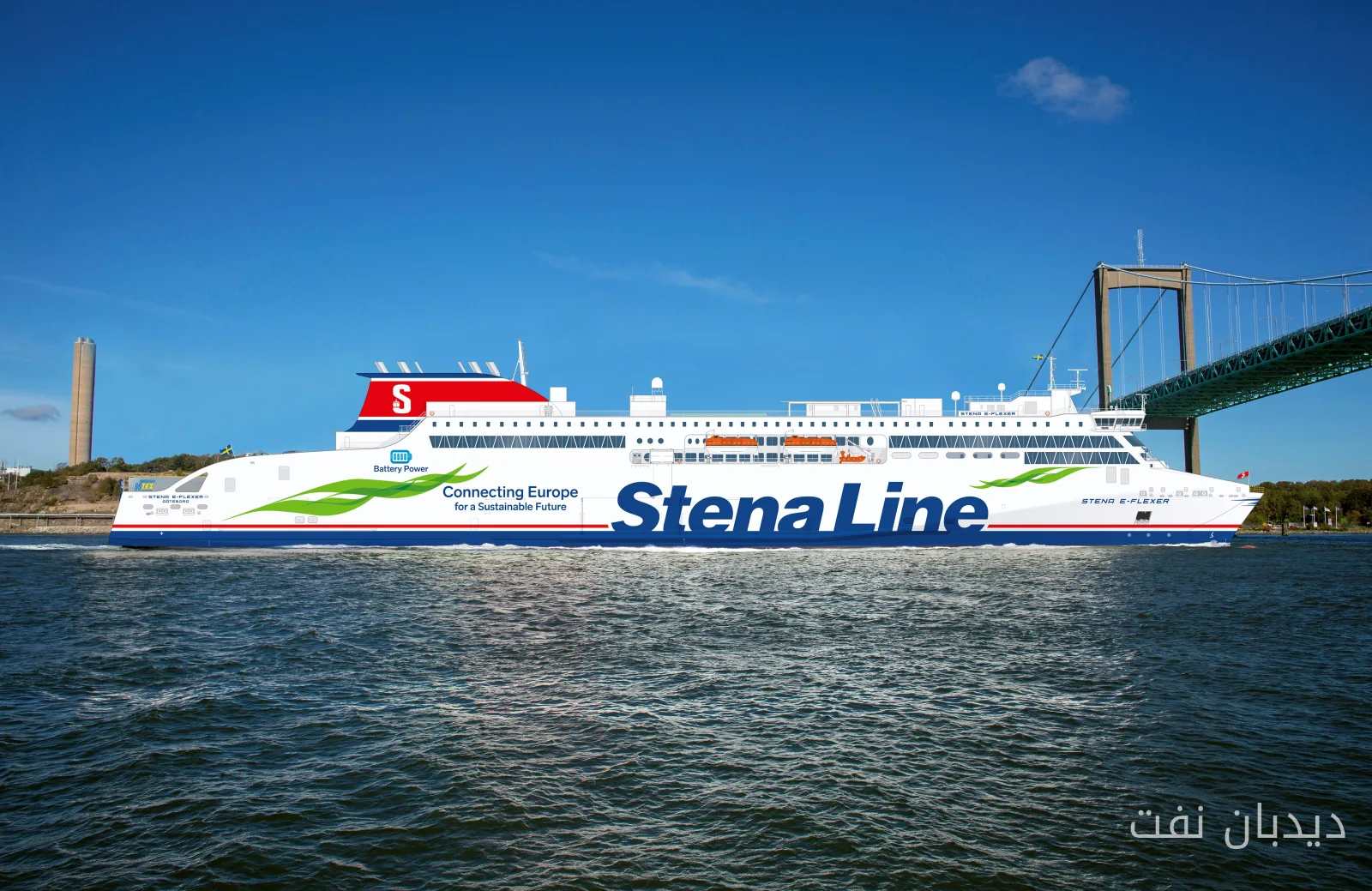
Stena RoRo, representing Stena Line, has ordered two new E-Flexer 2.0 ships from the China Merchants Shipbuilding Industry in Weihai. These ships are designed to provide flexibility and cost optimization, and they are adaptable to various passenger routes globally.
Details of the New Ships
The ships on order will represent a new generation of passenger vessels with high capacity for transporting passengers and rolling cargo. The new series of ships, named E-Flexer 2.0, has been specifically designed for the feasibility of future operations fully powered by batteries. For this concept, Stena RoRo has chosen a diesel-electric propulsion system that provides dedicated spaces for installing batteries with a capacity of 85 megawatt-hours.
Read more: The International Maritime Organization Emphasizes the Importance of Implementing Maritime Laws
These two new ships will be operational in 2030 for Stena Line services on the route between Gothenburg and Frederikshavn, Denmark. Per Westling, CEO of Stena RoRo AB, stated: "We have jointly developed these advanced ships with Stena Line to enable completely fossil fuel-free transport for passengers and cargo between Gothenburg and Frederikshavn."
Background of Cooperation with China Merchants
Stena RoRo's cooperation with China Merchants Shipbuilding Industry in Weihai has continued for ten years, with 21 ships ordered from this yard to date. This collaboration began in 2016 with an order for four E-Flexer RoPax ships and has now reached 17 ships, 13 of which are in operation. Additionally, four RoRo ships from the Stena NewMax and C-Flexer classes have also been ordered.
The new E-Flexer ships are designed to be 214 meters long, 6.4 meters deep, and 27.8 meters wide, with a capacity to carry 1,400 passengers and 2,720 meters of cargo. Due to their modern design and high flexibility, they are considered an ideal option for various passenger routes.
Battery technology is also rapidly developing, and the new ships are designed to allow for battery installations according to the needs and speed desired by ship operators. The amount of installed battery capacity can be influenced by factors such as battery cost, energy density, and fire safety, as well as the company's environmental policies and regulatory developments.
Read more: Saildrone Receives Danish Flag Registration for European Operations · Axleron Supplies Projects with Over 100 ACCX300-L Turbochargers