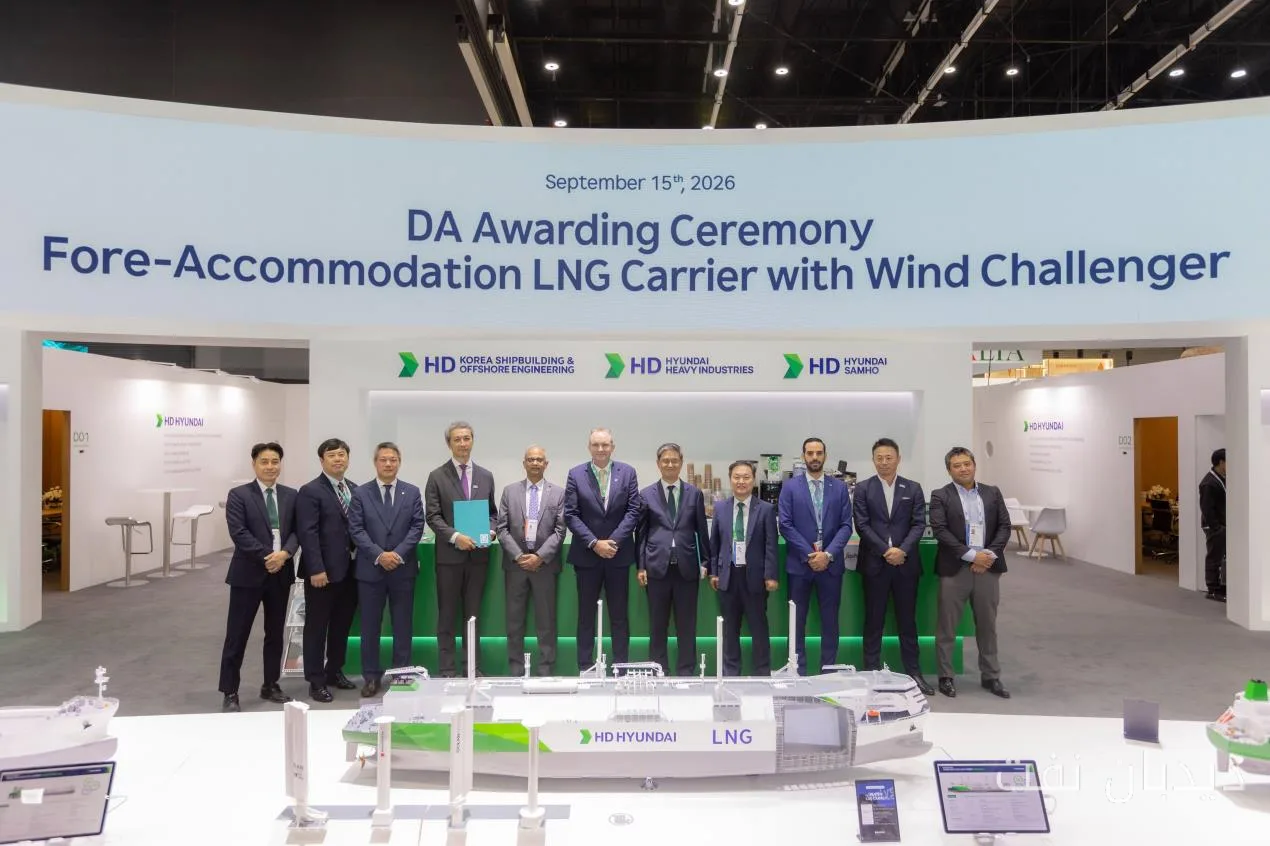
A new design for a liquefied natural gas (LNG) tanker that moves the accommodation block and bridge to the front of the ship and provides space for four wind-assisted sails has successfully obtained technical approval from Lloyd’s Register. This approval signifies the technical readiness of the design by HD Hyundai Heavy Industries (HHI) and Mitsui O.S.K. Lines (MOL) and represents an important step towards the commercialization of wind-assisted systems in LNG transportation.
Features of the New Design
Lloyd’s Register has granted design evaluation approval to the LNG tanker design with the accommodation block at the front and the Wind Challenger wind-assisted system developed by Mitsui O.S.K. Lines. This action confirms compliance with the requirements of the Wind-Assisted Propulsion Systems (WAPS) memorandum.
Read more: Mehdi Samimian announced the development of communication and fiber optic infrastructure in Semnan
Andy McCran, Growth Director at Lloyd’s Register, stated: “As LNG tanker designs advance, the industry needs robust technical frameworks to evaluate new technologies and configurations. This design evaluation demonstrates how joint development and independent technical assurance can contribute to delivering larger ship concepts with enhanced capabilities and better operational efficiency.”
Collaboration and Sustainable Development
Hongryul Ryu, Executive Vice President and CTO of HHI, said: “By closely collaborating with MOL and Lloyd’s Register, we have made progress in developing a new LNG tanker concept that safely combines the accommodation block arrangement at the front with the Wind Challenger in accordance with standards.”
He added: “Obtaining design approval for compliance with the WAPS memorandum signifies the technical maturity of this concept and represents an important step towards future commercial application. HD Hyundai Heavy Industries will continue to develop reliable and sustainable LNG tanker solutions for the next generation of maritime transport.”
By relocating the accommodation block and bridge to the front of the ship as a key feature of this concept, this spatial arrangement creates a quiet and clear area in the mid to aft section of the ship that can accommodate the MOL's Wind Challenger hard sail system while maintaining operational and navigational requirements. This enhances flexibility in the number, size, and placement of sails to maximize wind-assisted performance.
Richard Dias, Deputy Commissioner of Maritime Affairs of the Republic of the Marshall Islands, stated: “RMI Maritime Administration is pleased that this project has reached the design evaluation stage and looks forward to continuing collaboration with project partners. We are happy that this project will provide practical solutions using strong regulatory frameworks to achieve the International Maritime Organization (IMO) carbon reduction goals.”
This project includes evaluating technical areas related to the integration of wind-assisted systems on an LNG tanker, including navigational visibility, hull stability, structural stresses caused by hard sails, and emergency shutdown (ESD) systems. Additionally, hazard identification (HAZID) studies and risk assessments were conducted in accordance with the LR risk-based certification process.
Yoshihiko Sugimoto, Executive Officer and CTO of Mitsui O.S.K. Lines, said: “This design evaluation represents an important milestone in advancing the practical application of wind-assisted systems for LNG tankers. Through close collaboration with HD Hyundai Heavy Industries and Lloyd’s Register, we have demonstrated that the first LNG tanker with the accommodation block at the front and a design for four Wind Challenger sails can become a reality while ensuring safety, operational efficiency, and regulatory compliance.”
This concept showcases the potential of large-scale wind-assisted systems to further reduce greenhouse gas emissions from LNG transportation and represents an important step towards future commercial deployment.
Read more: The CEO of the Isfahan Electricity Distribution Company: Resilience of the power grid is a priority · Iran expanded the blacklist of tankers to 77 carriers