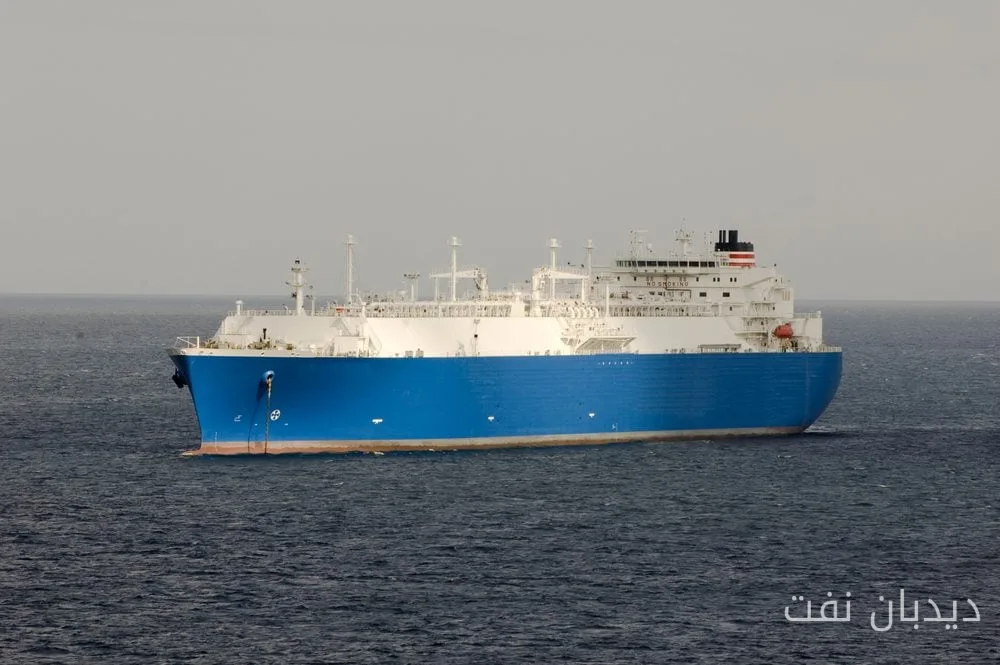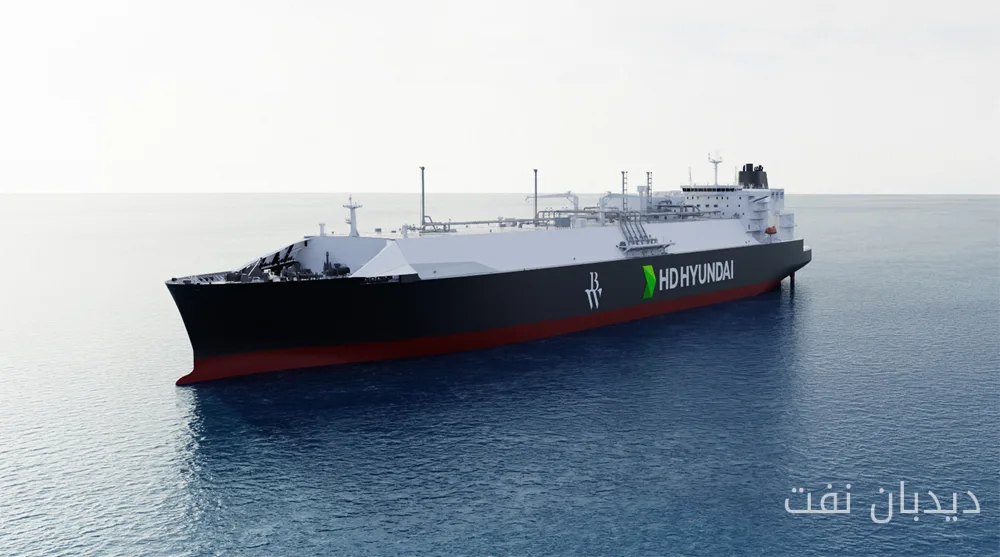
South Korea's HD Hyundai and Singapore-based BW LNG have announced progress in building the world's first three-tank LNG carriers. This new design increases loading capacity by up to 2,800 cubic meters (1.6%) and prevents loading limitations caused by larger ships.
Design Specifications and Capacity Increase
The design of these tankers has been developed by HD Hyundai in collaboration with the French cargo tank technology company GTT, with BW as the ship owner and DNV as the classification society. This design has been approved for tankers with a capacity of 176,800 cubic meters, and in June, BW placed an initial order for four tankers of this new design.
Read more: Great success for bound4blue in securing the eSAIL® design assessment
According to information provided by HD Hyundai, the company has managed to provide 2,800 cubic meters of additional space by removing an insulation wall from the 174,000 cubic meter tankers. This allows for more cargo transport, reduces transportation costs, and increases profits for ship owners. The conventional design for LNG tankers is a four-tank system.
Advantages of the Three-Tank System
By using a three-tank system, the space between cargo tanks is reduced while maintaining the size of the ship, thus increasing loading capacity. The LNG loading capacity of the tankers ordered by BW has expanded from about 174,000 cubic meters to nearly 176,800 cubic meters. BW has also noted that this design includes partial loading conditions that provide greater flexibility.
This design also brings additional benefits, including lower evaporation rates. HD Hyundai explains that by reducing the total surface area of the cargo tank, the amount of heat from the environment entering is decreased, resulting in a reduction in daily evaporation rates. The daily evaporation rate in the three tanks has improved by about six percent.
One of the main concerns in the design is cargo sloshing. As the size of the cargo tank increases, the impact of the cargo also increases. HD Hyundai has addressed this concern through detailed analysis of structural integrity and thermal reinforcement. The tankers will continue to use the proven Mark III membrane technology.
Reduction of Pollutant Emissions
BW emphasizes that these tankers have the lowest pollutant emission profiles in the industry, especially compared to previous generations of LNG tankers. These ships will use the dual-fuel marine engine WinGD X-DF 2.2, which is low-pressure and two-stroke. They will also include shaft generators.
Four ships will be built by HD Hyundai Samho in South Korea. The delivery of these tankers is scheduled from the fourth quarter of 2028 to the third quarter of 2029.
Read more: Lloyd's Register and Hyundai Heavy Industries have launched a new project for LNG vessels · The cargo of the tanker 'Seyed Kamal' was sanctioned on September 11, 2026