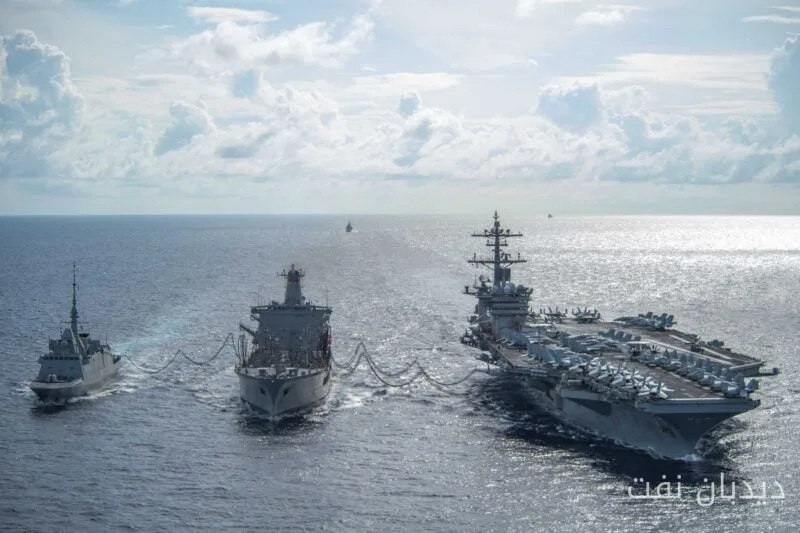
The Pentagon announced today that the USS Theodore Roosevelt (Nimitz-class aircraft carrier) has been deployed to the Persian Gulf along with 10,000 military personnel. This action is intended to provide more options for American commanders should President Donald Trump decide to escalate attacks against Iran.
Details of the Troop Deployment
The USS Theodore Roosevelt set sail from San Diego on Sunday and is heading towards the Middle East. With the arrival of this carrier, the United States could have three carrier strike groups in the region, the same number that existed in late April. However, no decision has yet been made regarding maintaining this level of naval presence. The USS George Washington remains in the area, but the USS George H.W. Bush has temporarily left the region.
Read more: Zelensky: Ukraine is ready for a maritime ceasefire in the Black Sea
Military and Economic Implications
This military move comes as Trump has stated that further military attacks against Iran are "possible." On Monday, the USS Makin Island Amphibious Ready Group, which includes an assault ship, aircraft, and 2,200 Marines, also headed towards the Middle East, providing more options for U.S. Central Command (Centcom). Currently, the USS Boxer Amphibious Ready Group is also conducting operations near the Strait of Hormuz.
In recent weeks, the United States has deployed two additional missile batteries to Qatar and Saudi Arabia to protect oil and gas facilities in those countries. This action is intended to ensure the security of U.S. security partners, reflecting Washington's willingness to protect key energy facilities in the event of new attacks.
Naval Challenges and Economic Status
Maintaining three carriers in the region may pose challenges for naval readiness. Ronald O'Rourke, a long-time naval forces analyst, emphasized that sustaining a two-carrier presence in this region for an extended period puts significant pressure on the Navy, and maintaining three carriers for a long time will create even more strain.
Following these developments, oil prices have also been affected, with concerns over military action causing Brent crude prices to rise by 0.4% to $102.74 per barrel. This price increase is due to military threats and signs of a more cautious approach from the U.S. Federal Reserve regarding further rate hikes.
Despite a pause in major military actions from either the United States or Iran, efforts to revive diplomatic negotiations continue. However, talks to end the war, which has now reached its eighth month, have stalled for various reasons, including Iran's control over the Strait of Hormuz.
Read more: China introduces the concept of 'Joudai Bread Land' in the South China Sea · Trump administration criticizes IMO carbon regulations at the UN General Assembly