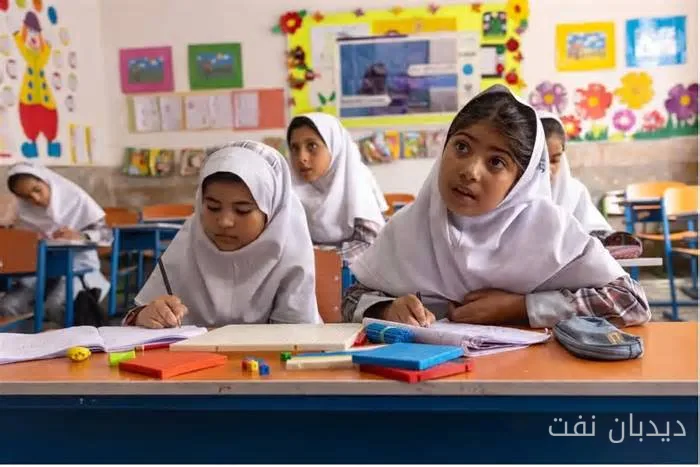
The Deputy Minister of Primary Education stated that the Ministry of Education has become the authority for making decisions about school closures, announcing that this authority has been granted to the ministry to make decisions based on the conditions of each region instead of a nationwide closure. Rezvan Hakimzadeh emphasized the importance of preserving students' instructional time in the country, noting that instructional time in Iran is significantly less than in many other countries.
Instructional Time and Its Impact on Learning Outcomes
Hakimzadeh pointed out that the time students spend in class and the duration of instruction per day is significantly less than in countries that achieve better results in international assessments, adding: "This issue affects students' learning outcomes." He also mentioned that in Iran, the first places to close for various reasons are schools. Issues such as air pollution, energy imbalance, and snowfall are some of the excuses that can lead to school closures.
Read more: New Analysis by Ursa Shipbrokers on Changes in the Cargo Ship Market
The Experience of the COVID Era and the Need for Policy Change
Hakimzadeh further referred to the experience during the COVID era, stating: "At that time, Iran was one of the countries with the longest duration of school closures." He noted that many countries, despite having advanced technological facilities, reopened their schools after about a month. He also mentioned that reports from the World Health Organization indicate that schools are not the starting point of COVID and that children are not at serious risk.
The Deputy Minister of Primary Education emphasized that a comprehensive view of instructional time and school time is necessary, stating: "School should be the last place to close." Hakimzadeh stressed the need for a fundamental reconsideration of policies and cultural change to prevent unnecessary closures.
Analysis of School Closures and Energy Imbalance
He also referred to a report from the Educational Studies Research Institute that examined and compared various factors leading to school closures. This report investigated how much school closures could help reduce energy imbalance. The results of this study showed that school closures have little impact on reducing energy imbalance, and therefore, such decisions should be made with greater care.
Hakimzadeh concluded by mentioning the standards for school closures during air pollution conditions, stating that in many countries, even when pollution levels are higher than what is reported in Iran, schools continue to operate. He emphasized that if necessary education is provided and consumption behavior is reconsidered, school closures can be avoided.
Read more: Why Iran's Oil Does Not Convert to Power Despite Abundant Reserves? · Installation of Solar Energy Systems in Coolville Schools: A New Transformation with 1.5 Million Dollars