Saeed Tavakoli, the CEO of the National Iranian Gas Company, has announced that approximately 230 million cubic meters of the country's daily gas production capacity has been damaged due to enemy attacks. He explained that through efforts made, about 100 million cubic meters of this capacity has returned to operation, but 130 million cubic meters of lost capacity has still not been restored.
Consequences of Gas Imbalance in the Upcoming Winter
This reduction has occurred at a time when the country's gas network was already facing structural imbalance. This means that the lost capacity has not only created a new need but has also added to the existing shortfall, increasing the gap between supply and demand. Tavakoli has also warned that due to the imbalance and reduced production capacity, there is a possibility of gas tension in 11 provinces of the country.
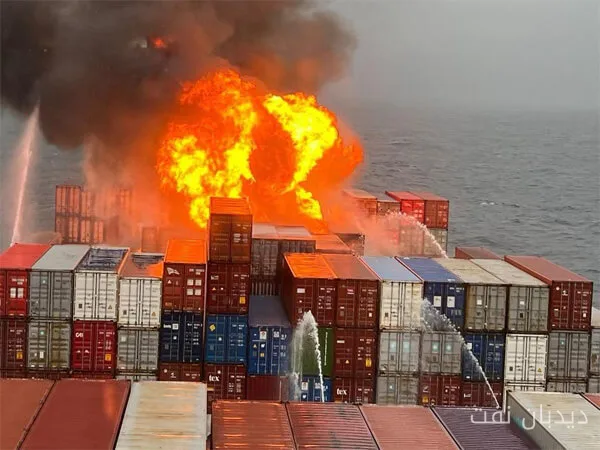
Read more: Fire on Two Container Ships and Efforts to Control Them
Provinces at Risk of Gas Tension
According to Tavakoli's explanations, the provinces of Mazandaran, Golestan, and North Khorasan are in a more difficult position, and in provinces such as Tehran, Alborz, Semnan, Kerman, Isfahan, East Azerbaijan, West Azerbaijan, Ardabil, Kurdistan, and Razavi Khorasan, there may also be issues in gas supply in some areas. This situation depends on the geographical location of the provinces and their distance from production centers and transmission capacity.
Gas consumption in the residential, commercial, and industrial sectors has increased by about 70 million cubic meters, equivalent to 30%, in recent cold days. According to Tavakoli, for every one degree drop in temperature during peak consumption days, about 25 million cubic meters is added to the country's daily gas demand. These figures indicate that even relatively limited changes in temperature can put significant pressure on the network.
Government Measures for Managing Consumption and Providing Alternative Fuels
In the gas distribution structure, meeting the needs of the residential sector during cold days is a priority. Experience from previous years has shown that during peak consumption periods, some industrial units have faced gas restrictions for one to two months and have had to use alternative fuels or reduce their production capacity. This issue is not limited to reducing energy consumption in factories, as energy-intensive industries such as steel, cement, and petrochemicals need stable energy supply to continue production.
One serious concern for the upcoming winter is the potential increase in the use of liquid fuels in power plants. When gas supply to power plants is restricted, the use of diesel and mazut can be proposed as a solution to prevent disruptions in electricity production. Ismail Saghab-Asfahani, the head of the Organization for Optimization and Strategic Management of Energy, has emphasized that the government's policy is to prevent mazut burning, but this decision depends on the level of savings by the public and industries.
Officials have also stressed the necessity of reducing energy consumption and have recommended that the temperature of home heating devices be set to 20 degrees Celsius. However, solving the imbalance issue does not solely depend on consumer behavior and there is a need for investment in energy infrastructure as well.
Read more: Reza Amiri Moghadam's Explanation about the Situation of Iran-Pakistan Borders · Oil Tanker in the Persian Gulf Targeted by Two Unknown Projectiles