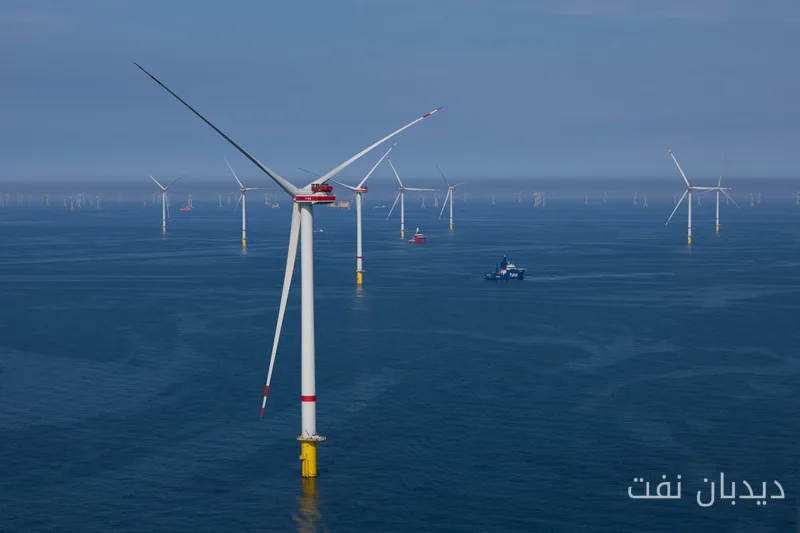
The He Dreiht wind farm, which is considered Germany's largest offshore wind project, was inaugurated last week in the North Sea. This project, which includes 64 15-megawatt wind turbines located approximately 50 miles from Borkum and 68 miles from Heligoland, is progressing towards full commissioning with the goal of producing a maximum of 960 megawatts of electricity.
Details of the He Dreiht Project
Greg Stanton, Chairman of the Board of EnBW, stated at the opening ceremony: "He Dreiht is the largest single investment made by EnBW in the field of renewable energy." He emphasized that to achieve secure, affordable, and clean electricity, we need more projects similar to He Dreiht. He also highlighted the importance of courage and pragmatism in the necessary changes to Germany's energy system.
EnBW secured the contract for this project in the first round of Germany's offshore wind farm auctions in 2017, without benefiting from government subsidies. The project has been fully financed through long-term power purchase agreements, with EnBW holding 50.1 percent of the shares through a project company. The remaining 49.9 percent belongs to a consortium of global and Norwegian investors. The total investment in this project is approximately 2.4 billion euros.
Impacts on Various Sectors
The long-term power purchase agreements (PPAs) signed for electricity generation help companies achieve price stability and long-term planning certainty. This project is particularly significant for the technology sector and is expected to contribute to digital growth and the development of artificial intelligence. He Dreiht's contractual partners include major companies such as Evonik, Google, and the DHL Group.
Construction operations for He Dreiht began in mid-2024 in the North Sea. With a hub height of 142 meters and a rotor diameter of 236 meters, each rotation of the rotor generates enough energy to supply four households for one day. The grid operator, Tennet, is responsible for connecting the wind farm to the power grid.
The transition of He Dreiht to regular operations will be a gradual process that includes the gradual connection of turbines to the grid, testing, and commissioning. Currently, several turbines have been connected to the power grid, and the remaining ones are expected to join soon. Based on current progress, the wind farm should be fully operational in the coming months.
EnBW emphasizes that this project is part of its overall strategy to expand renewable energy. Currently, the company's total installed capacity is about eight gigawatts (GW), more than double the figure from 2018, and accounts for over 70 percent of the total installed production capacity.
Germany currently has an operational offshore wind capacity of approximately 10.8 gigawatts by mid-2026, with the government's long-term goal of reaching 70 gigawatts by 2045. Recently, the German federal cabinet made amendments to the offshore wind energy law to update the construction framework. This new framework includes bilateral contracts (CfD) and extends the standard operational lifespan for new installations from 25 to 35 years, but has faced criticism and calls for further policy reforms to support the necessary investments in renewable energy.
Read more: Flylogix Drone Flight Over Statfjord B Oil Platform in Norwegian Waters · Strengthening Energy Cooperation Between Germany and the UAE with a Focus on LNG Supply