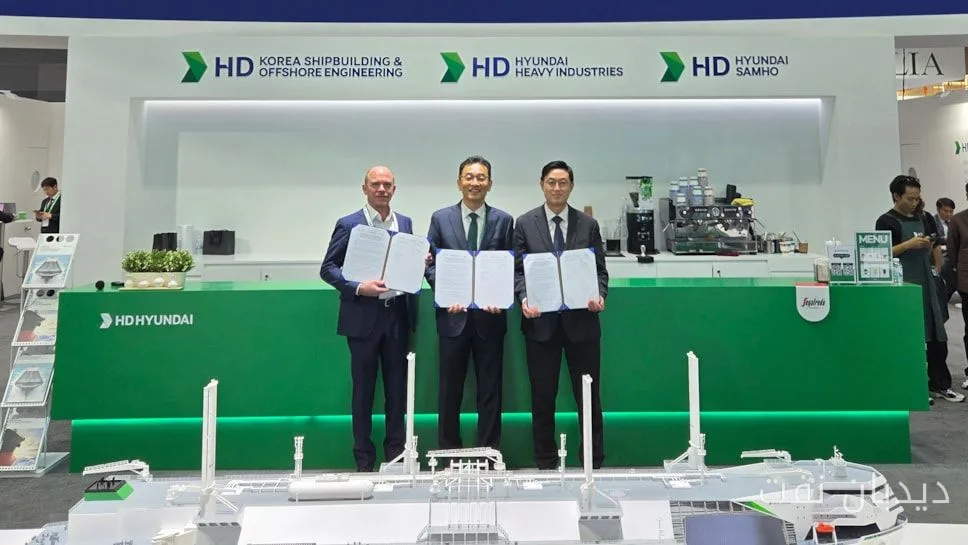
HD Korea Shipbuilding & Offshore Engineering (HD KSOE) and Siemens have recently signed an agreement to develop digital twin technology aimed at better assessing and understanding leak behavior in ammonia fuel ships. This collaboration involves combining computational fluid dynamics (CFD) analysis with digital twin technology to quickly predict ammonia dispersion behavior in the event of a leak.
Purpose of Developing Digital Twin Technology
Chang Kwang-pil, head of the Future Technologies Institute at HD KSOE, stated: "The transformation of artificial intelligence in the shipbuilding industry is not limited to the application of new technologies; it is an innovative process in how we work. We expect that the integration of artificial intelligence and digital twin technologies in research and development will be significantly accelerated." This technology has the capability to assess a wide range of leak and accident scenarios in the early design stages of ships.
Read more: ABS Grants Conceptual Design Approval for 15,000 TEU Nuclear Container Ship
Role of Each Project Partner
HD KSOE will be responsible for developing ammonia safety systems and leading related experimental research. Meanwhile, Siemens will provide simulation analysis and digital twin technology, while the American Bureau of Shipping (ABS) will supply the digital twin-based safety assessment methodology.
Byung Joon Oh, country manager for digital industries software at Siemens in Korea, also commented: "Physics-based simulation and advanced digital twin technologies are key to ensuring the safety and reliability of next-generation ship engineering. Through close technical collaboration with HD KSOE and ABS, we will accelerate the safety of ammonia fuel ships and continue digital innovation in the global maritime industry."
Read more: Crown Estate's One-Year Investment in the Welsh Marine Energy Testing Center · Marfret Acquires Two Container Ships from Chinese Yard