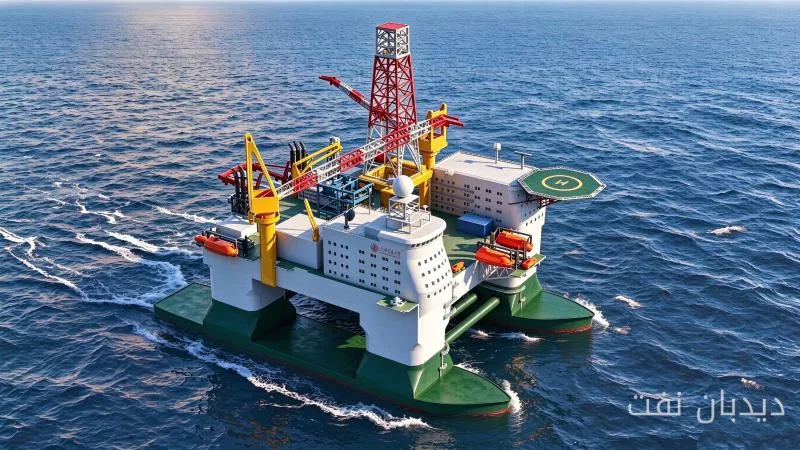
China has recently signed a contract to build the world's first floating marine research island. This island is designed as an autonomous vessel capable of long-term habitation at sea and repositioning. The construction of this project will begin at the Shanghai Waigaoqiao Shipbuilding Factory, which has a history of building the largest semi-submersible drilling platform at a depth of 3000 meters.
Details of Construction and Ship Features
This vessel will be built at a cost of over $413 million and is expected to be delivered in June 2030. The construction and design of this ship will be based on a catamaran hull, known for its good capabilities at sea. The dimensions of this research island will be 138 meters by 85 meters (453 feet by 279 feet) with a main deck height of 45 meters (148 feet). Additionally, this vessel will weigh 74,000 tons and have a speed of 11 knots.
Read more: Advancements of the MARPOWER project in marine carbon reduction technologies
Research Capabilities and Objectives
The research island is designed to withstand marine conditions with waves of 20 to 30 feet (approximately 6 to 9 meters) and storms with winds exceeding 165 miles per hour. This vessel will feature six floating laboratories for heavy marine equipment technologies and systems, and will conduct research and observation in various fields including meteorology of marine crises and long-term marine ecosystems. It will be capable of accommodating 238 crew members and researchers.
This project has been introduced as a pioneering concept that combines long-term habitation with the ability to quickly relocate to new locations. This vessel will serve as an important tool for scientific research in the seas and oceans in the near future and represents China's advancements in marine technologies.
Read more: Support of the Ministry of Energy for the development of renewable energies · China has dispatched naval forces to monitor the US warship in the South China Sea