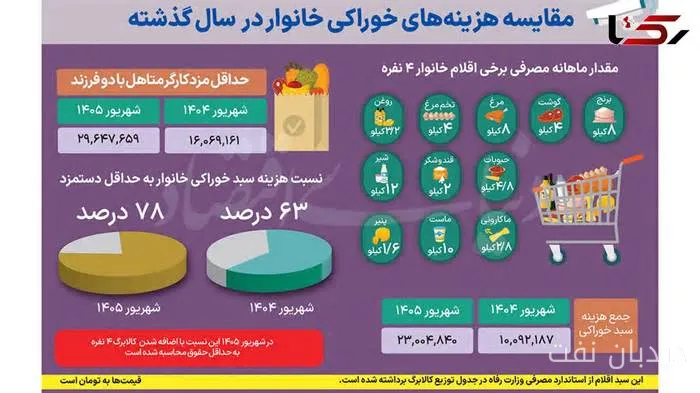
The point-to-point inflation of food items in Shahrivar 1405 reached 121.8%, indicating negative impacts on household purchasing power and increased production costs. In this situation, nearly 78% of the minimum wage of a four-person household is spent on food purchases, while the one million toman food voucher only covers 17% of this household's food expenses.
Increased Pressure on Household Livelihoods
According to data from the Statistical Center of Iran, rising production costs and recession in businesses due to escalating inflation have weakened demand and reduced production capacity. This reality has severely impacted household livelihoods, and consequently, supportive policies have not been fully effective. Additionally, statistics from the Central Bank's research arm indicate that the activity of industries and mines in the three months leading to Mordad 1405 decreased by 8% compared to the same period last year.
Read more: Reduction of Electricity Imbalance by Ehsan Zabehizadeh as a Sign of Improvement
Factors Influencing the Inflation Rate
Economists believe that to control the inflation rate, there is a need for stable management. The high inflation rate in Iran is due to monetary, exchange rate, and structural factors. Increasing liquidity and budget deficits, through rising nominal demand and weakening the national currency, contribute to price increases. Fluctuations in the exchange rate and trade restrictions also raise the costs of importing essential goods. Alongside these factors, changes in currency and subsidy policies can exert additional pressure on prices.
In this context, the removal of the preferential exchange rate in Dey 1404 and the transfer of the cost of securing currency to higher rates have put significant pressure on the prices of imported goods. In response to this situation, policymakers allocated a one million toman food voucher to all income deciles, but over time and with the rise in general price levels, the effectiveness of this voucher has diminished.
From the beginning of Dey 1404 to Shahrivar 1405, the prices of food items have increased by an average of about 6% per month. If the food voucher's value had increased in line with inflation, it should have been more than 1.6 million tomans. With the allocation of a 1.5 million toman food voucher to the bottom three income deciles, it is expected that the financial burden of securing livelihoods will be somewhat reduced, but with the continuation of inflation, there is a need for new financial resources to increase the voucher's value.
The trend of food inflation data shows that the monthly inflation rate of food and beverages has decreased from 15.5% in Bahman 1404 to 2.3% in Shahrivar 1405. However, despite this decrease, one cannot fully expect price stability, as the main factors driving inflation still exist. This situation may lead to the formation of "inflationary memory," where the inflation rate remains high even after the weakening of primary factors.
Therefore, controlling inflation requires stabilizing expectations and the credibility of economic policymakers. In a situation where inflation expectations are formed among households and businesses, economic actors adjust their behavior in a way that perpetuates inflation.
Read more: Increase in Crude Oil Prices to $109 and Europe's Concerns in Winter · Iranian Oil Tanker Shipment Faces International Sanctions



