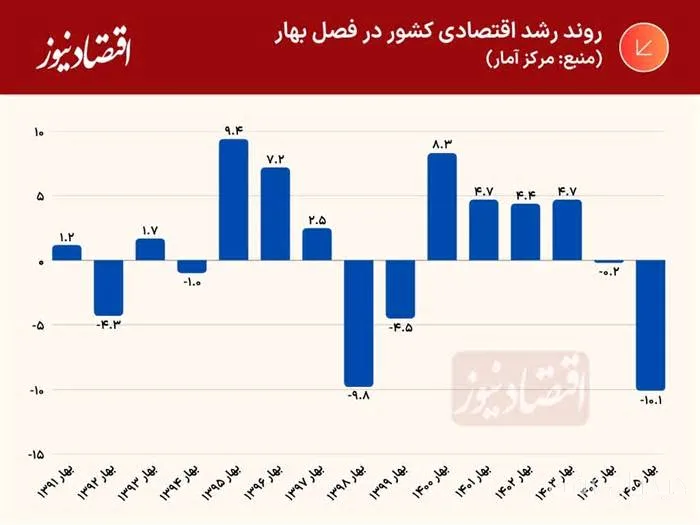
Iran's economic growth in Spring 1405 reached its lowest level in the past 15 years, decreasing to negative 10 percent. This severe decline is particularly evident in the oil and natural gas extraction sector, which reached negative 26.4 percent. This situation has occurred due to years of misguided policy and heavy economic sanctions.
Reasons for the Decline in Economic Growth
Multiple factors have contributed to the decline in Iran's economic growth. The intensification of sanctions in the years 1389 and 1390, as well as the United States' withdrawal from the JCPOA in recent years, have all led to a significant reduction in production and investment. Additionally, recent wars with Israel and the United States have exacerbated this crisis. Estimates indicate that the size of Iran's economy in Spring 1405 has decreased by about 10 percent compared to Spring 1404.
Read more: Return of Personal Fuel Cards to Refueling Requirements in Iran
Condition of Economic Sectors
Different sectors of Iran's economy have been affected differently. The growth of non-oil industries and mining, as well as services, has been severely negative, while only the agricultural sector has reported positive growth. In terms of demand, household consumption expenditure and government spending have decreased by negative 4 percent and negative 1.7 percent, respectively. This situation clearly indicates that Iran's economy is entering a recession.
Furthermore, inflation also increased to 4.2 percent in Shahrivar, reaching 89.8 percent in point-to-point inflation. This increase indicates severe pressure on households and the purchasing power of the people. This time, inflationary pressure has mostly come from non-food items and services, changing the distribution of inflationary pressure.
Conclusion
The current state of Iran's economy reflects severe challenges in both growth and inflation. Livelihood support can act as a temporary relief, but to achieve real change in economic conditions, there is a need to restore production capacity and investment in the economy. Policymakers must focus on economic growth alongside controlling inflation to achieve sustainable increases in household welfare.
Read more: Deputy Speaker: Fuel Prices in America Determine the Situation of the Strait of Hormuz · 300 Billion Dollar Plan by the Crown Prince of Abu Dhabi for Developing Trade Infrastructure